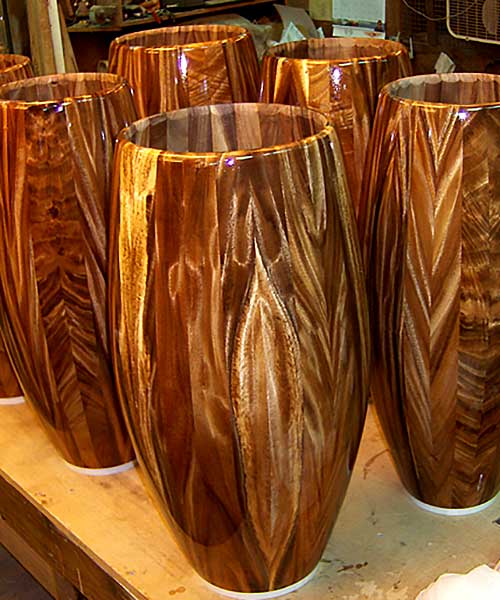
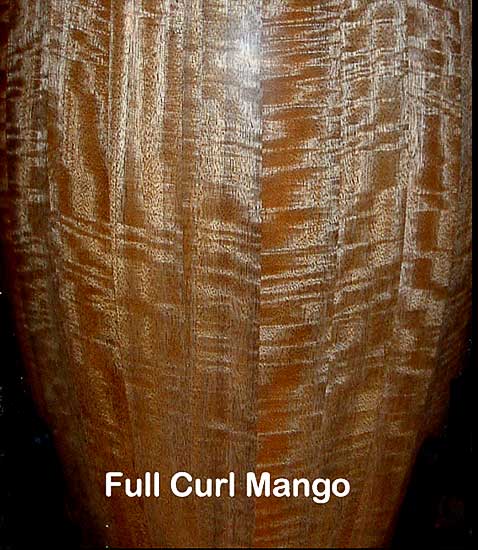
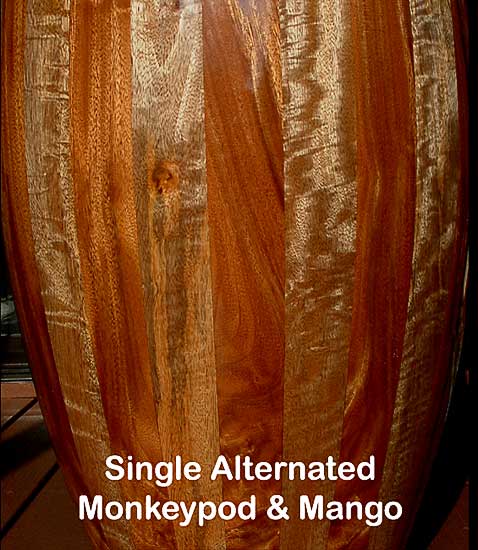
As creators of Fine quality Wood bodied Drums, We have to choose between the best quality of wood in which there are many different varieties, as well as the combinations and grades of wood available from those selections. We do this and have created this explanation of our wood choices to help you choose the drums that will make your choice a part of your musical expression and make your personal statement. All woods have particular variations of their grain contruction or make-up. The grain contruction adds to it's strenght, beauty and tonal quality. Variations and the wood choice are shown below.
Solid Koa Wood: Mature Koa is a premium choice of wood. Trees are either scarce, or in hard-to-access mountainous locations, and the price of Koa is likely to only increase further in the future. With the tree endemic to Hawaii only, and with supplies dwindling, Koa is likely to be rather expensive. Also, boards of highly figured and/or curly Koa can command fantastic prices. Koa is one of the best choices of wood for musical instruments. A durable tight grained hard wood with superior tonal qaulities and beautiful looks.
Koa is widely considered to be the most beautiful and useful of Hawaii's native hardwoods, and along with Monkey Pod and Mango, it is the most common Hawaiian species to be imported into the lower 48 United States. The word "koa" means "warrior" or brave or bold in Hawaiian.
Visually, Koa has been compared to Mahogany, while in terms of working and mechanical properties, it has been compared to Walnut. Because of its nearly equal tangential and radial shrinkage, (its T/R Ratio is only 1.1), Koa tends to be quite stable regarding environmental changes in humidity.
Grain is usually slightly interlocked, and sometimes wavy. Uniform medium to coarse texture. Tree Size: 65-100 ft (20-30 m) tall, 3-5 ft (1-1.5 m) trunk diameter.
Solid Monkeypod Wood: So named for the spiral-shaped fruit pods which the tree bears. Outside of Hawaii, one of the most common names for the species is Raintree, which is due to the leaves tendency to fold up at night or during periods of rainfall, allowing rain to pass through its broad canopy to the vegetation below. Trees are commonly planted in tropical regions as an ornamental shrub or shade tree.
Monkeypod is called by many different names in many different cultures, and its lumber is likewise used for a number of different purposes depending on the locale, ranging from utility wood and construction purposes to fine furniture.
Monkeypod usually trends a little bit cheaper in price than Koa, all other things being equal. Boards with figured grain patterns are much more expensive. Color tends to be a golden to dark brown, sometimes with darker streaks. Sapwood is usually thin and yellow/white, clearly demarcated from the heartwood. Monkeypod is sometimes seen with highly figured curly or wild grain patterns. Tree Size: 100-125 ft (30-38 m) tall, 3-4 ft (1-1.2 m) trunk diameter.
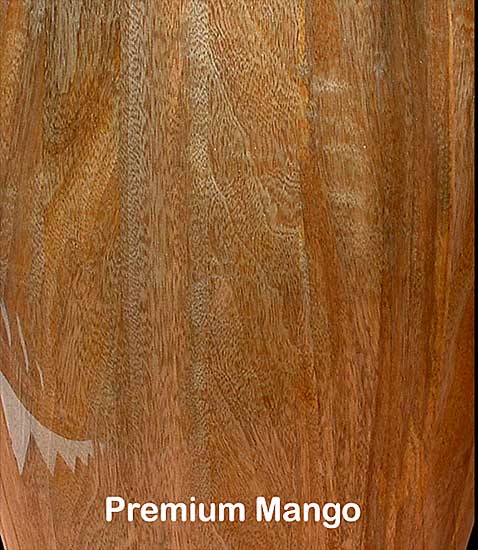
Solid Mango Wood: Here in Hawaii, Mango is second only in popularity to Hawaiian Koa wood. The reason is it has such a cheerful beauty, much like the Hawaiian people. Although its origin is not Hawaii, it has become well adapted in the last 600 years. So well, that Hawaiian Mango wood is distinct in appearance. Giant curls, insane grain and most of all its rainbow of colors. Mango is also used extensively for beautiful furniture, ukuleles and guitars.
Mango is a technically a hardwood and of course the tree produces the wonderful orange mango fruit. These trees typically grow to a 4' to 6' girth at 50 ft. tall. Therefore, one branch can produce several conga drums. We at Volcano Percussion only purchase trees that have been removed thru natural mortality or development.
The natural colour of mango wood is light to golden brown. Mango wood is also receptive to wood staining, which produces rich deep brown colours. Mango wood also shows prominent grain patterns, similar to oak and mahogany. These are highly sought after when polished. Unlike many other hardwoods, mango wood is relatively easy to work. This makes it an excellent choice for carpentry and furniture-making; it's easy to shape, plane and sand while boasting great strength. Tree Size: 50-100 ft (24-30 m) tall, 3-6 ft (1-1.2 m) trunk diameter.
A Few Wood Related Definitions:
In general, hardwood comes from a deciduous tree which loses its leaves annually and softwood comes from a conifer, which usually remains evergreen. Hardwoods tend to be slower growing, and are therefore usually more dense. Softwood trees are known as a gymnosperm.
We Primarily use the premium hardwoods listed above for our drums .
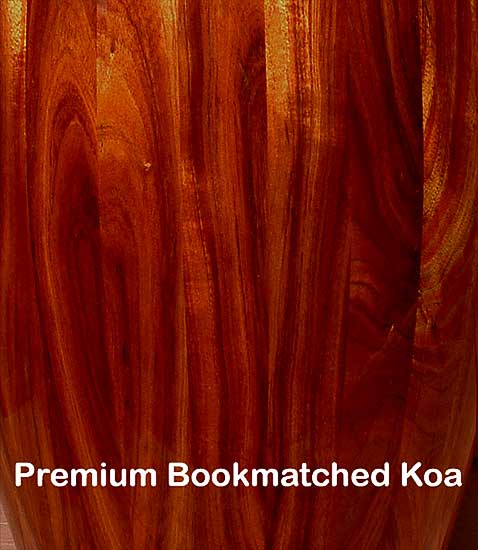
Premium: Hand chosen for superior grain, figure, color and uniformity.
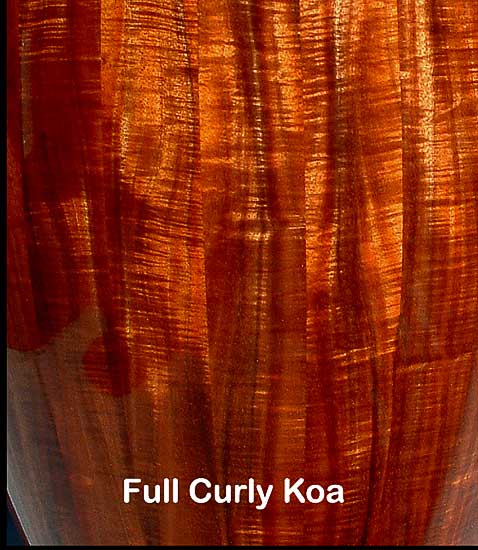
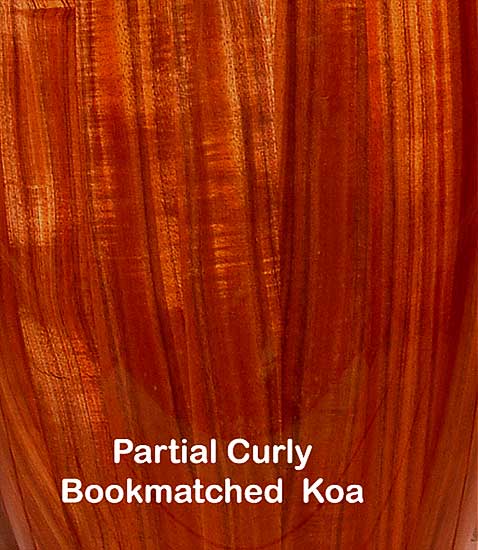
Curl: is compression grain perpendicularly crossing the face of a board producing alternate stripes of hard and soft board fiber. Creates dynamic looking grain sections.
Full Curl: All curly grade.
Premium Partial Curly: A combination of premium grade and curly grade.
Figured: In wood, figure refers to the appearance of wood, as seen on a longitudinal surface (side-grain): a "figured wood" is not plain. The figure of a particular piece of wood is, in part, due to its grain and, in part, due to the cut, or to innate properties of the wood. It's unique look (pattern) of a particular piece of that lumber.
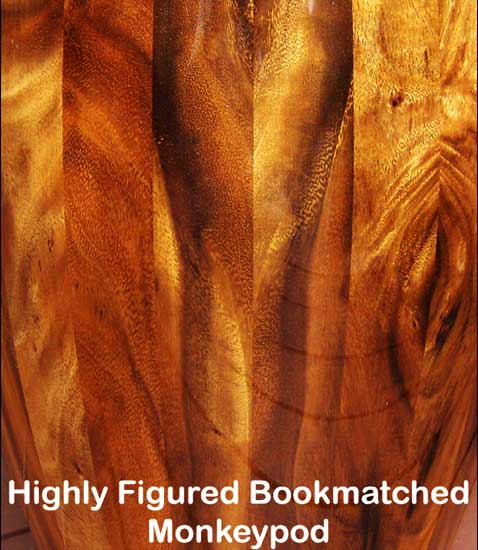
Highly Figured: Wide exaggerated figure as in occasionally found in Monkeypod wood.
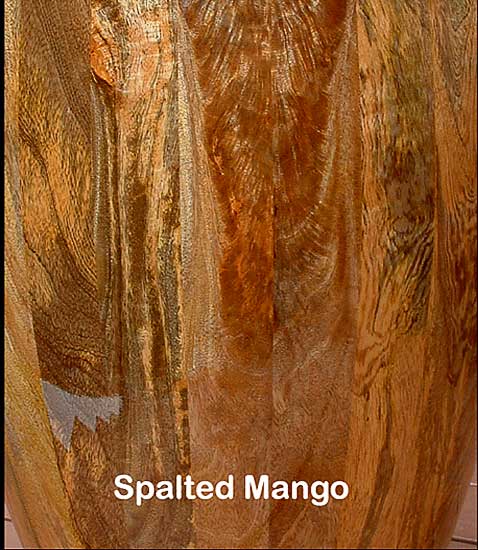
Spalted Wood: In the decorative wood market, spalted wood is in high demand. Spalting is caused by certain white-rot decay fungi growing in wood-primarily hardwoods such as maple, birch, and beech. The fungi create "zone lines" in the wood where territories of competing fungi meet.
Grain: Technically, the word grain refers to the orientation of wood-cell fibers. That's quite different from figure, which describes the distinctive pattern that frequently results from various grain orientations. Grain also defines it's strenght as typically the tighter the grain the stronger the wood.
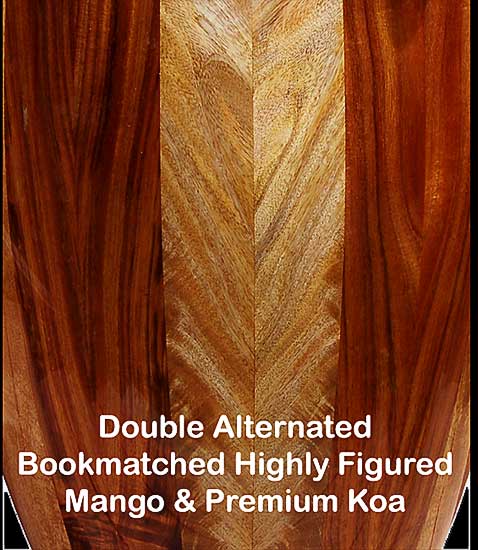
Bookmatched: is a symmetrical way to match the veining of two slabs of wood so that the veining of the two slabs are closely aligned to mirror each other, like an opened book. Basically to match and mirror each other. Is the process in which 2 staves are split in half becoming a matched pair, similar to a mirror reflection of each other in appearance.
Alternating Staves: Alternating stave woods can be done either as single staves or double staves. A single alternated stave example would be like Koa and Mango wood staves side by side (striped).
Double Alternated: An example would be like 2 book matched Monkeypod staves next to 2 book matched Mango wood staves.